Friday, 8 October 2010

Parrot Crossbill Predation


Eurasian Pygmy Owl and Parrot Crossbill (from http://niaolei.org.cn/posts/10555)


I thought that photo might get your attention ! No not from my Deeside site but rather somwhere colder and much further East ! Apologies to the anonymous photographer (as no name was attached to it) but I have linked to the original website.

Crossbills are strange birds; they are very wary when coming down to the ground to drink, get grit or bones (for calcium) yet when they are feeding in trees you can stand only a few feet from them and they are oblivious to your presence (helpful for reading rings !).

Even with my 1000's of hours field time I have never witnessed Crossbill predation per se eg. an actual kill, though I have observed unsucessful attempts by Sparrowhawks on several occasions, and Merlins (twice), both aimed at Parrot Crossbill flocks. Clearly Pygmy Owls have some adaptation for catching Parrot Crossbills ! Predation by avian predators it would seem is a rare occurence.

In Scotland there are several species that can predate Crossbill nests (eggs and nestling predation): Red Squirrel (Greys don't tend to occur in Pine Crossbill habitats), Corvids, Pine Marten, Great Spotted Woodpecker (and Green Woodpecker at one of my sites) and Sparrowhawk ( I have witnessed the latter though the chicks successfully 'exploded' and evaded predation). However, this said, the severity of the weather, particularly wet, snow and wind combined with the availability of cones (and how 'open' the cones are) will have far more impact on productivity than all the predators combined.


Friday, 1 October 2010

"Last Catch", 30th August 2010

This is my last catch of crossbills, from August 30th in upper Deeside. I caught two Common Crossbills (and a Meadow Pipit !), that were lured in to the vicinity of the drinking pool with a taped call - they were trapped in an area of natural/semi-natural Scots Pine. Common Crossbills have been present, feeding on the pines (which are closed) and nearby Larch and Spruce for the last two months:


Female Common Crossbill


Common Crossbills are usually fairly recognizable in the hand being much smaller bodied than Parrots and a bit smaller than Scottish. The key measrement however is bill depth. This one was quite big with a minimum bill depth of 10.6 mm but still well within range for Common Crossbill.

Common Crossbills can sometimes be difficult to age precisely due to an extensive breeding season that can last most of a calendar year (depending on cone/seed availability) and also due to the fact that some suspend their moult (if irrupting and/or breeding in their 2cy) whilst other juvenile 1/2 cy's can have extensive or erratic post juvenile moult - though the former will still often show 3 generations (or ages) of feather and can be aged quite easily. Another factor is that crossbill 'years' don't necessarily conform to our calender years eg. January to December, and as such the age codes ringers use may not conform like they do for other bird species. The dead crossbills that Dougie Preston sent me from the 2009 invasion had examples of arrested or suspended post juvenile moult - these will feature in a later post.

The female had adult type wing feathers that were quite worn, no old (or juvenile) greater coverts so was aged as a Euring Age 4 or a 4F. She had also replaced two primary coverts (indicated below, and much darker than the older feathers):


Moulting Primaries and Primary Coverts


One of the associated primaries P1, slightly darker than the older feathers, was nearly fully grown and the other was just coming in so this bird appeared to be active wing moult. Another useful ageing criteria was provided by Jenni and Winkler's fantastic Moult book which states that Common Crossbills never replace PC1 and PC2 (primary coverts 1 and 2) or even PC3 as part of their post juvenile moult so the age of a Euring 4 ( born before the present calendar year is safe). This female also had a brood patch score of 4 meaning she must have bred some time over the Summer and would explain the commencement of wing moult with the first two inner primaries.

The male's bill depth was 0.1mm bigger - positive assortative mating ? ! This bird was also in wing moult with two new primaries and associated primary coverts. Quite a big billed curvirostra, though overall bill is 'rectangular', culmen is not steeply downcurved and the tip of the lower mandible is at a shallow upward incline:


Male Common Crossbill


Notice how the bill appears big relative to the size of the head (which was small) ? After releasing the two birds one after the other, and recording their flight calls (both Common type Fc's) I noticed a colour ringed crossbill feeding in a Scots Pine tree right by the ringing station. I got the scope out and it took some time to get the positions of all 3 colours and the metal but I eventually confirmed it as Parrot Crossbill that was ringed 15/10/06 at the same site. This bird was on its own and I took the opportunity to collect and measure some of the cones it was foraging on. The first one it dropped was this cone:


Parrot Foraged Cone


The above cone resembles the shredded appearance of a Scots Pine cone that has been worked by a Scottish or Common Crossbill , yet the bird that foraged it was defintely a Parrot on bill depth and also flight call. So what gives ? Well, clearly like all things crossbill there is no definitive, and inconsitency and variation prevails ! I guess it depends on the structure of the individual cone as the bird then dropped a cone that was more typical of a Parrot foraged closed Scots Pine Cone:


Typical Split Parrot Foraged Cone


I have observed Parrot Crossbills only partly prising open certain cones many times so my conclusion is that crossbills cannot be identified with 100% certainty by examining the condition of the cones that they depredate, though for most birds this may be a safe assumption and is generally useful. Parrot Crossbills 'split' the cones by making an entrance to the scale with the culmen tip then 'working' that hole, by inserting the mandible then manipulating it through up to 90 degrees which then splits the scales - which is why Parrots are 'bull-necked' and have extremely well developed neck and cheek muscles. They will also sometimes literally 'peel' the scales. It is a bit of a 'domino effect' - once they have got one scale open the others are much easier. They will work a cone like this one for anything up to one and half two minutes at this time of year.

Hopefully when the wet and windy weather finally subsides I can get out and catch some more ! A more thorough review of Parrot feeding will appear in the future as I have scads of pictures of birds feeding, including some colour ringed Parrots feeding on Larch ( which apparently they don't feed on according to some authors !).


© Lindsay Cargill 2010


Friday, 3 September 2010

Culbin Sands, Sunday 22nd August

Some of you may have gathered from my tweet that I was at Culbin Sands near Nairn a couple of Sundays ago. For those that don't know it Culbin is a massive Scots and Corsican Pine plantation on the sand dunes south of Nairn. It is home to Corsican Pines, Crested Tits, Scottish Crossbill and Southern Hawker (the target for the day). Below is just a brief summary of the day.


Spot The Corsican Pines ?

On arriving Common hawkers were patrolling the car park and there was an abundance of Scotch Argus butterflies which was a good start. All the way to the main Dragonfly pool Crested Tits were calling and we got great views - even one bathing at around 10 feet (though too shaded for a photo shot). I have heard recent reports of people missing Cresties at Culbin - my advice is to really familiarise yourself with the calls as you will hear birds long before you see them ( a bit like crossbills actually). With so many about you really would have to have been walking about blindfolded and ear plugs in not to have encountered them this day.


Arriving at the main pool Common Hawker males were patroling but within a minute or so a Southern Hawker male appeared followed by another and a dog fight ensued. S. Hawkers, very Common in England, are very scarce in Scotland and only seem to have a hold on this NE corner of Scotland - the area from Banff through to Beauly- and I understand that they are now dispersing South through the Great Glen and are at Fort William. Perhaps like other species of odonata they have been unintentionally ( or intentionally) introduced ?


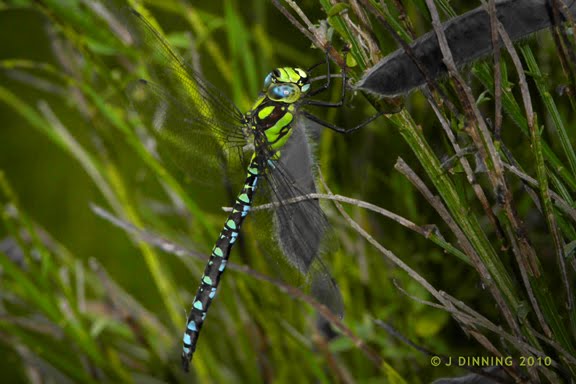
Male Southern Hawker


We found a cracking Southern Hawker exuvia about 3m out from the bank on a stem. I decided it was worth getting my feet wet so waded out to claim it. It turned out to be a perfect female SH exuvia. More Cresties were calling and moving around the dragonfly pool, but suddenly a Crossbill flew over and Remembird recorded this:


Pants Common Crossbill Sonagram


Now, to my ears this sounded almost cross between a Fc4 (glip) type call and a Fc1 (parakeet), but this is not clear on the sonagram, where the call looks more Fc1 ish. However, though it looks like a Fc1 "parakeet" type ( or 1B) it is possibly slightly too low in frequency for most Fc1 calls and is similar in frequency to Parrot ! To be honest it is like many of the vague calls I get sent by other people and in those cases I often shrug my shoulders, so I am going to practise what I preach with this call I made and call it as "can't be sure" ! What I will say is that aurally ( in the field) it was not Parrot ( which I have much experience) and it sounded 'clippy' so possibly a Fc1 afterall, but just a low pitched one. I think if it was a Fc4 the last ypward component would have shown up.

On the way back to the car, we came across the massive catepillar for a Goat Moth scrabling about on the path:


Goat Moth Catepillar.....Yummy !


Apparently these are quite unusal and scarce so a lucky find. The other Dragonfly pool had 4 Spot Chasers Emeralds and Common Blues but no Common Darters which were present there last year.

If you are up in the Inverness area Culbin is very worth a visit and could easily produce Goshawk as well as the goodies we had. Definitely more Crested Tits than Abernethy from my experience.


Wednesday, 28 July 2010

Getting All Excited About Scottish Crossbill !

I am in process of re-evaluating some of my early recordings for a couple of upcoming papers (finally), one of which is now drafted and just needs the supporting sonagrams and pictures compiled and added in. Raking through the material I came across this sonagram, probably one of my best ever of a Scottish Crossbill, recorded near its nest at Glen Tanar on 11th April 2005 ( yes I really have been doing this stuff since then ! EDIT: actually, since 2004):


Scottish Crossbill Excitement Call


A fantastically clear sonagram of a typical Excitement Call C (EcC) diagnostic of Scottish Crossbill per Summers et al, 2002. The really amazing thing is this was recorded with my Czech Monocor short gun microphone (which was as noisy as hell) and my first Mini Disc recorder a Sony MZ-710 ! Not a Telinga or Fostex in sight ! Just shows you what you can do with a bit of fieldcraft (and field time) and the right conditions ( there was no wind and the bird was alarming about 12 feet away from the mic). In those pre HiMD days I had to re-record ALL the tracks  from the line out into Audio Lab via the computer and then process the sonagrams using a program called GRAM32.

I should add that this call type is now quite rare, having only recorded it in this form a few 'handful and footfall' times. Some interesting material regarding the call structures of Scottish Crossbills is imminent.....all is not what it seems, keep tuned.

Saturday, 24 July 2010

Catching Pine Crossbills, Upper Deeside, 21st June 2010

Crossbills are notoriously difficult to catch in order to ring as you cannot bait sites like you can for other finches - they are specialised to feed primarily on various pine cones and there are usually millions of them about so no joy there ! Usually crossbills are caught when they come in or out of drinking pools. I believe Dutch ringers use 'artificially' created drinking sites and also use caged decoy birds to lure crossbills in which sounds very efficient ( and interesting). Here in the Scotland we only tend to use sites that the crossbills themselves visit naturally on their own accord and we don't use decoys ( though an endorsement to allow this can be applied for). Many man hours can be spent finding and reconnoitring these sites which is why I, and others, are quite guarded about where we are operating and catching birds. Last year one of my pools was compromised twice by photographers (the worst kind of disturbance) so don't take offence if I don't disclose sites, it is nothing personal !

Crossbill's drink obviously to sustain themselves, however, there is also a more 'cultural' purpose to the process. The birds will often sit in a perching tree near to or directly above the pool and the dominant male will sit right on the crown of the tree, sometimes singing or preening. There is a 'pecking' order to how the bird are organised within the tree, with more dominant birds asserting their authority, and often these birds will drink first. One often finds that these birds may actually drink twice - I have observed this several times thanks to colour ringing individuals. However, sometimes extra keen juveniles bail in first and these are often caught more easily. I refer to such pools as 'cultural' pools that is they are long term historical drinking sites where social behaviour and interaction can be performed. This is opposed to sites where they drink 'ad hoc' or opportunistically eg. near to where they are feeding and are thirsty at a particular moment, a puddle below a tree for example. All of this makes them exceedingly difficult to catch in any sort of numbers.

Monday 21st June had near perfect conditions: warm. overcast, and very importantly, little wind. Whilst setting up at dawn several birds came in to one of the pools I was hoping to catch. I backed off and let them down to drink - they could be trapped later when they came back ! I set up two nets and settled down very nearby so that the nets could be monitored constantly.Only an hour had passed and I caught some birds, a family of Parrot Crossbills and a Siskin (other birds drink at crossbill pools). The Siskin was processed first and released quickly.

The male Parrot Crossbill was an adult and was in post-breeding moult ( inc.wing moult):


Parrot Crossbill


Again, the bill structure to me is clearly Parrot, but for many birders this would be classified as Scottish. The minimum bill depth was in excess of 13mm so not Scottish !

The female hadn't started moulting her primaries but some tail feathers were being moulted. She also had a brood patch score (BP) of 4 (meanind she had finished brooding/breeding). The bill structure was Parrot:


Parrot Crossbill


The juvenile had a rather 'clean' look to its bill structure, almost Scottish in appearance but still too deep biometrically to be anything but Parrot Crossbill:


Parrot Crossbill juvenile


These birds were colour-ringed and processed quickly and released into the same tree whilst sound recordings were obtained of their flight calls. The colour ring sequence is unique to each bird and allows the birds to be 'recaptured' (by observation) without actually physically catching it again. Much useful information can be gathered from these observations of colour ringed birds and so far I have very important data on call association, feeding ecology, breeding behaviour as well as site fidelity and movements. The rings have no impact on the activities of the crossbill and some that were ringed in 2006 are still being observed at the same location.

I only had a chance to have a quick drink myself and another bird was caught. This bird, an adult male Scottish Crossbill, already had a metal ring on its right leg so was a retrap. Consulting my notebook it was ringed by myself and my trainer on 3rd September 2006 at the exact same pool:


Scottish Crossbill


This bird was also in post breeding wing moult with several primaries in the process of being replaced.  The minimum bill depth, believe it or not, is over a milimetre less than the Parrots that were caught, even though the shape is similar. This bird was processed and released very quickly, with the flight call recorded as he flew.

There was a lull of a few hours in the early afternoon. This so often happens, the birds just dossing about, preening, singing. Some interesting by-catch kept me on my toes with several Siskins and my first ever juvenile Stonechat. The latter was very interesting as there are usually several pairs with territories at this site but this year there have been none, so the bird I caught was most likey a roving juv from further up the Glen.

By late afternoon the action started again with two juvenile Parrot Crossbills caught in the other net I had set. These were probably caught as I have described above, that is piling in eagerly before the dominant adults ( who then sussed out the situation !). However, though they don't perhaps look as good, catching juveniles is actually better in many ways because we can age them exactly, that is as a first year or Euring 3J. We can also assume that these birds are on their natal site or certainly not far from it, so any movements can be valuable.

The first juvenile I processed had a stonking bill:

Parrot Crossbill Juvenile

From the profile you can really see that this bird, a typical Parrot Crossbill, is 'bill heavy'. Notice the very pronounced gonyeal bulge in the lower mandible.

The next bird, possibly a sibling, also had a pronounced Parrot type bill bill and was slightly smaller overall:


Parrot Crossbill Juvenile

The bird is being held in the 'reverse' ringers grip in order that the tip of the lower mandible can be photographed in the profile. Crossbills can be either left or right handed, or billed as it were, just like humans. I class the cross as being to the right or left based on the direction of the lower mandible tip, in this case to the left.

All in all a very sucessful day with a total of 5 Parrot Crossbills, one retrap Scottish Crossbill, 5 Siskins, 1 Chaffinch and a Stonechat caught naturally without bait. The retrap Scottish for me was the highlight in several ways. Hopefully the in hand bill profiles will be of help to birders in determining ( or not !) the Crossbill species and the text giving an insight in to the intricacy of crossbill study